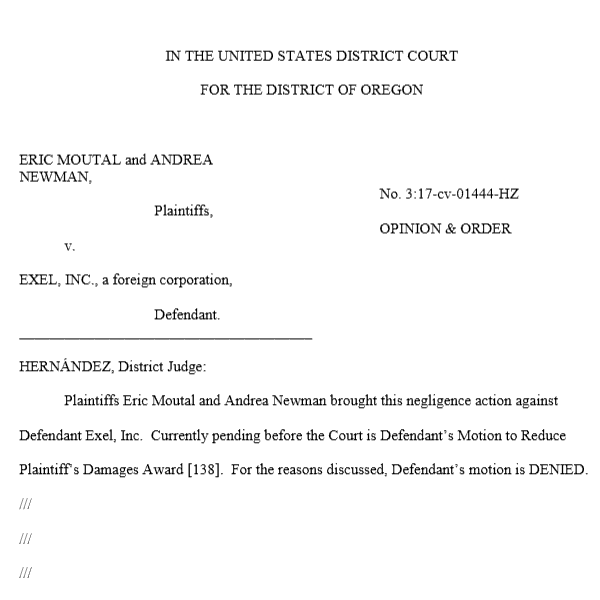
Moutal v. Exel, Inc. vs. U.S. District Court, District of Oregon
Barton Trial Attorneys is proud to report a verdict in excess of $9 million in an Oregon truck accident case involving flagrant negligence and the life-altering injuries that resulted therefrom. Barton successfully argued for $1 million in punitive damages for every mile over the speed limit. The case went to trial in December 2019; the jury returned a plaintiff verdict with substantial economic, noneconomic, and punitive damages.
The verdict was upheld in post-trial motions and then on appeal to the 9th circuit.
Verdict Highlights
- Case Citation: Moutal v. Exel, Inc., No. 3:17-cv-01444-HZ (D. Or. Mar. 29, 2021) (Opinion & Order, ECF 167). Verdict and opinion are matters of public record.
- Case Type: Commercial trucking / catastrophic personal injury
- Plaintiff’s Attorney: Brent Barton, Barton Trial Attorneys
- Location: U.S. District Court, District of Oregon (Portland) before Judge Marco A. Hernández
- Injuries Involved: permanent impairment
- Jury Verdict: ~$5.26 million compensatory + $4 million punitive: a million dollars for every mile per hour over the limit
The Accident
Eric Moutal and Andrea Newman, Canadian citizens on vacation, were bicycling on the shoulder of I-84 in the Columbia River Gorge near Hood River on August 3, 2016, when an Exel employee struck them with his semi-truck. Moutal’s leg was nearly severed; it was saved from amputation, but only after multiple surgeries; he was left with permanent functional deficits. Newman survived with injuries of her own.
The driver saw Moutal’s body flying through the air in his right-view mirror. He pulled off the road. The first thing he did was inspect his truck for damage.
Two witnesses ran back to the crash site to help; the truck driver did not go with them. Instead he told them the cyclists had been at fault; that they had ridden into his lane, that he’d had no choice but to hit them, and that he was worried about losing his job.
He did not call 911. He called his supervisor and asked him to call, citing poor cell reception, though other witnesses at the scene had no trouble making calls. He did not retrieve the first-aid kit from his truck. He did not put out the reflective triangles he was carrying to warn oncoming traffic. A passing nurse stopped and rendered aid. Witnesses redirected traffic away from the scene while the driver responsible for the crash stood idly by.
When an Oregon state trooper arrived, the driver began actively interfering with the investigation. He interrupted the trooper’s interview of a witness to ask what they had seen. When the trooper sent the witness back to his car for a private conversation later, the driver followed him, pressing his version of events, trying to gain agreement. The trooper repeatedly had to instruct the driver to leave the witness alone.
The Defense Argument: “Ordinary Negligence”
Evidence showed that the truck driver was going just 4 miles over the posted limit. While this was in violation of state law (and company policy), it gave the defense a tidy, relatable talking point: four miles an hour is not that big a deal, and most of us often go slightly over the speed limit, particularly on freeways. They also tried to argue that the bicyclists didn’t have to drive on the freeway.
The defendants also tried to get into evidence that the bicyclist had a beer for lunch, which we kept out of evidence. Speeding alone, the trucking company’s lawyers argued, quoting Oregon cases going back to 1959, “amounts to nothing more than ordinary negligence.”
Some plaintiff attorneys might have settled out of court on this fact alone; Barton Trial Attorneys did not back down.
Barton Trial Attorneys’ Response
“Four miles an hour over” was only one side of the story, and only one element of the driver’s wanton negligence. The truck driver weaved in and out of the shoulder for miles: so much so that the motorist behind him thought he was falling asleep. He neglected to heed the “Bicycles on Roadway” signs, despite having driven the route countless times. He never saw the brightly-clothed cyclists, and didn’t move to the fast lane despite having ample room.
The driver’s behavior after the accident was almost as egregious; after seeing Moutal’s body fly through his mirror, his first act was to inspect his truck for damage. As mentioned earlier: he rendered no aid, deployed no reflective triangles, and didn’t call 911 himself; he called his supervisor to do so, and told witnesses the cyclists were at fault and that he was worried about losing his job. He interfered with a state trooper’s investigation and was ordered off-scene.
Brent Barton and the team at Barton Trial Attorneys made the argument that “four miles per hour” wasn’t any kind of defense: that, in fact, punitive damages should be rendered to reflect the profound damage caused by this seemingly minor infraction. In a bold move that tested the viability of Oregon laws governing punitive damages, he asked for punitive damages of $4 million: 1 million for every mile driven over the speed limit.
Trial and Verdict
A five-day jury trial began December 9, 2019. The jury returned a verdict of $400,000 to Newman; to Moutal, the extended $1,258,893.75 economic, $4 million noneconomic, and $4 million punitive damages for his losses.
The court found the jury could reasonably have concluded the driver was falling asleep, purposefully ignoring the road, or significantly distracted. They also found that his decision to keep driving, weaving, for miles showed reckless indifference to the danger a fatigued or distracted semi poses on a highway shared with bicyclists. The defendant’s conduct afterward, the court held, showed singular focus on the impact that the crash would have on his life, not the plaintiffs’.
Exel moved for judgment as a matter of law and, alternatively, a new trial or remittitur: all efforts to reduce or remove the punitive award. The defense’s core position was that this was “garden variety negligence” that can’t support the size of the plaintiff award. Both motions were denied.
A Note on Punitive Damages in Oregon
Oregon law permits punitive damages only on “clear and convincing evidence” — a standard higher than the preponderance standard that governs most civil cases — that the defendant “has shown a reckless and outrageous indifference to a highly unreasonable risk of harm and has acted with a conscious indifference to the health, safety and welfare of others” (ORS 31.730). The jury was instructed on that heightened standard, found the standard met, and awarded $4 million accordingly.
An Oregon Truck Accident Verdict That Still Resonates Today
Trucking companies defend these cases by shrinking them. They isolate the single most defensible fact — “four miles per hour,” in this case, but there are plenty of similar examples — and ask a jury to evaluate an entire case on a single fact alone. A competent truck accident attorney will contextualize a case to bring the full story into focus.
In Moutal, Barton Trial Attorneys put the whole event in front of the jury: the thousand trips past signs he never saw, the miles of weaving, the man who checked his bumper before he checked on the person bleeding on the shoulder. We are proud of this result, and honored to represent injured Oregonians in truck accident cases across the state.
Barton Trial Attorneys handle catastrophic trucking cases nationwide. We take ten cases or fewer at a time, with two trial attorneys and a full staff devoted to each one. To speak with a truck accident attorney about your case, call (541) 265-5377.