

Category: Cases Won

  • Case Results: Inside the Rajneeshpuram Litigation

    In the early 1980s, a religious movement took over a small town in Oregon’s high desert. Its leader, the Bhagwan Shree Rajneesh, was best known as the guru with a fleet of Rolls-Royces. His right hand was his personal secretary, Ma Anand Sheela.

    Most people know the story now from documentaries. I knew it from the inside. For a time, I was one of the lawyers standing between the people of Antelope and the Rajneeshees. This is the story of how I got there, what it was like to face them, and the verdict that came out of it.

    The Rajneeshpuram Litigation: A Timeline

    1981: The Rajneeshees bought the Big Muddy Ranch, a 64,000-acre property near Antelope, Oregon, for $5.75 million. Antelope had about 40 residents. The newcomers began building a city on the ranch. Within months, Antelope’s residents, sensing what was coming, tried to disincorporate their town so it couldn’t be taken over. Rajneeshees registered to vote in Antelope and defeated the measure. 

    May 1982: Residents of the ranch voted to incorporate their own city: Rajneeshpuram. After local elections and resignations, the Rajneeshees held a majority on the Antelope City Council. The Rajneeshee-controlled council eventually renamed Antelope “Rajneesh.” 

    September 1984: Rajneesh personal secretary, Ma Anand Sheela, contaminated salad bars at restaurants in The Dalles with salmonella with the help of her associates. The goal was to make enough voters sick to swing the November Wasco County elections. According to the CDC’s investigation, 751 people became ill in the largest bioterrorism attack in U.S. history. (It also backfired; Residents turned out in force and voted the Rajneeshees down.)

    1985–1986. Sheela fled the country in 1985, and the Bhagwan was arrested and left the United States under a plea agreement. In November 1985, Antelope’s remaining residents voted unanimously, 34 to 0, to take back their town’s name. Sheela was later extradited and, in 1986, pleaded guilty to charges that included attempted murder, assault, and wiretapping. She served 29 months for these crimes.

    How I Became Involved

    Before Antelope, I had done work for John Jaqua, a Eugene lawyer and past Oregon State Bar president. Jaqua helped Phil Knight and Bill Bowerman launch Blue Ribbon Sports, the company that later became Nike, and sat on Nike’s board for decades. 

    Bowerman was the legendary University of Oregon track coach and head coach of the 1972 U.S. Olympic track and field team. His brother lived in Antelope, and openly despised what the Rajneeshees were doing to his town. He called Bill, and Bill called his friend John Jaqua. And that was when John called me.

    How the Rajneeshees Tried To Intimidate Me

    This case was unlike any situation I’d ever encountered, before or since. The Rajneeshees were organized, well-funded, and relentless. They had their own lawyers, their own government, and their own police force.

    Everywhere I went, Sheela seemed to be there. She was striking, sharp, and impossible to ignore. I was reminded of how General Motors once had Ralph Nader followed by private investigators after he exposed the Corvair: a campaign GM’s own president later apologized for before the U.S. Senate. Pressure like that is meant to rattle you—and, honestly, it did for a time—but I redoubled my focus and concentrated on the job at hand.

    Then they came to my home to intimidate me. The Rajneeshees parked a car with two of their members in front of my house in Newport, around the clock, every day. It was meant to intimidate my family and me. I installed a state-of-the-art alarm system, and alerted the Newport police; they parked a marked patrol car, with a city officer, directly behind the Rajneeshees’ car, also around the clock. 

    After three days, the Rajneeshees went home.

    The Defamation Case against Ma Anand Sheela

    During the course of her involvement with the Antelope, OR community, Rajneesh’s personal secretary, Ma Anand Sheela, installed herself as chair of the local school board. When a mother stood up and raised concerns about the curriculum at an open school board meeting, Sheela told the woman that if she had stayed home more, maybe she wouldn’t be a widow. (The woman’s husband, an Oregon State Police officer, had recently died in an accidental shooting.)

    That senseless and cruel comment was meant to humiliate a grieving mother in front of her community. It was the Rajneeshee strategy in miniature: if you couldn’t be outvoted, you could be shamed into silence.

    In 1985, I filed a defamation case on the woman’s behalf against Sheela.

    Sheela’s lawyer was Swami Prem Niren, also known as Philip Toelkes: the Bhagwan’s personal attorney and, by then, the elected mayor of Rajneeshpuram. Niren was one of the most skilled trial lawyers I have ever faced. He was smart, prepared, and persuasive.

    Nevertheless, the jury returned a verdict of $625,000 for my client. You can see this verdict, along with others, on our Results page.

    40 Years Later: Why The Rajneeshpuram Litigation Still Matters

    Our successful defamation verdict did not bring back our client’s husband. It didn’t end the Rajneeshee era on its own, or stop the tsunami of outside money that essentially bought a town. What it did was tell one woman, in front of her whole community, that what Ma Anand Sheela said to her was wrong—and that the Rajneeshees, regardless of their influence, had to follow the law like everyone else.

    That is what juries are for, and why my legal career has centered around the power of ordinary people. When power is concentrated in the hands of people who think the rules don’t apply to them, a jury of ordinary citizens is one of the few places where everyone stands on equal ground.

    I’ve carried that lesson through my career. I took this mission into the first lawsuit against the Boy Scouts of America to go to trial, the first lawsuit against the Vatican over clergy abuse, and the institutional abuse cases our firm still takes today. Our opponents will change, but our work—our values—never will. 

    You find the person who was hurt, you tell their story truthfully, and you don’t back down, even when the other side plays dirty.


    Barton Trial Attorneys: Standing Up to Powerful Opponents for More than 40 Years

    When people come to us, they almost always say they don’t want what happened to them to happen to anyone else. That is why we do this work: to level the playing field between ordinary people and entities that are bigger, richer, and better organized than the people they hurt. ‘

    As a boutique trial firm accepting only a handful of cases at a time, we’ve successfully taken on religious movements, national institutions, hospitals, and corporations. Learn more about our firm, our core values, and our team — or call for a free consultation:

    Barton Trial Attorneys. You’re not a file. You’re family.
  • Barton Trial Attorneys Receive Landmark $4 Million Punitive Verdict in Truck Accident Case

    Barton Trial Attorneys Receive Landmark $4 Million Punitive Verdict in Truck Accident Case

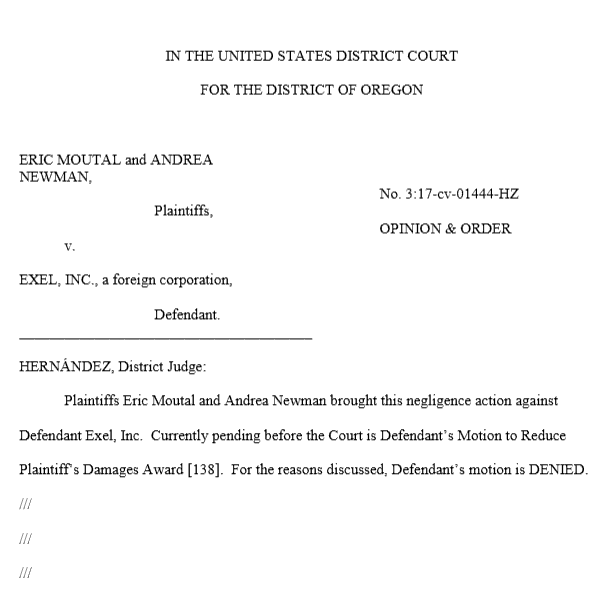
    Moutal v. Exel, Inc. vs. U.S. District Court, District of Oregon

    Barton Trial Attorneys is proud to report a verdict in excess of $9 million in an Oregon truck accident case involving flagrant negligence and the life-altering injuries that resulted therefrom. Barton successfully argued for $1 million in punitive damages for every mile over the speed limit. The case went to trial in December 2019; the jury returned a plaintiff verdict with substantial economic, noneconomic, and punitive damages.

    The verdict was upheld in post-trial motions and then on appeal to the 9th circuit.

    Verdict Highlights

    • Case Citation: Moutal v. Exel, Inc., No. 3:17-cv-01444-HZ (D. Or. Mar. 29, 2021) (Opinion & Order, ECF 167). Verdict and opinion are matters of public record.
    • Case Type: Commercial trucking / catastrophic personal injury
    • Plaintiff’s Attorney: Brent Barton, Barton Trial Attorneys
    • Location: U.S. District Court, District of Oregon (Portland) before Judge Marco A. Hernández
    • Injuries Involved: permanent impairment
    • Jury Verdict: ~$5.26 million compensatory + $4 million punitive: a million dollars for every mile per hour over the limit

    The Accident

    Eric Moutal and Andrea Newman, Canadian citizens on vacation, were bicycling on the shoulder of I-84 in the Columbia River Gorge near Hood River on August 3, 2016, when an Exel employee struck them with his semi-truck. Moutal’s leg was nearly severed; it was saved from amputation, but only after multiple surgeries; he was left with permanent functional deficits. Newman survived with injuries of her own.

    The driver saw Moutal’s body flying through the air in his right-view mirror. He pulled off the road. The first thing he did was inspect his truck for damage.

    Two witnesses ran back to the crash site to help; the truck driver did not go with them. Instead he told them the cyclists had been at fault; that they had ridden into his lane, that he’d had no choice but to hit them, and that he was worried about losing his job.

    He did not call 911. He called his supervisor and asked him to call, citing poor cell reception, though other witnesses at the scene had no trouble making calls. He did not retrieve the first-aid kit from his truck. He did not put out the reflective triangles he was carrying to warn oncoming traffic. A passing nurse stopped and rendered aid. Witnesses redirected traffic away from the scene while the driver responsible for the crash stood idly by.

    When an Oregon state trooper arrived, the driver began actively interfering with the investigation. He interrupted the trooper’s interview of a witness to ask what they had seen. When the trooper sent the witness back to his car for a private conversation later, the driver followed him, pressing his version of events, trying to gain agreement. The trooper repeatedly had to instruct the driver to leave the witness alone.

    The Defense Argument: “Ordinary Negligence”

    Evidence showed that the truck driver was going just 4 miles over the posted limit. While this was in violation of state law (and company policy), it gave the defense a tidy, relatable talking point: four miles an hour is not that big a deal, and most of us often go slightly over the speed limit, particularly on freeways. They also tried to argue that the bicyclists didn’t have to drive on the freeway.
    The defendants also tried to get into evidence that the bicyclist had a beer for lunch, which we kept out of evidence. Speeding alone, the trucking company’s lawyers argued, quoting Oregon cases going back to 1959, “amounts to nothing more than ordinary negligence.”
    Some plaintiff attorneys might have settled out of court on this fact alone; Barton Trial Attorneys did not back down.

    Barton Trial Attorneys’ Response

    “Four miles an hour over” was only one side of the story, and only one element of the driver’s wanton negligence. The truck driver weaved in and out of the shoulder for miles: so much so that the motorist behind him thought he was falling asleep. He neglected to heed the “Bicycles on Roadway” signs, despite having driven the route countless times. He never saw the brightly-clothed cyclists, and didn’t move to the fast lane despite having ample room.

    The driver’s behavior after the accident was almost as egregious; after seeing Moutal’s body fly through his mirror, his first act was to inspect his truck for damage. As mentioned earlier: he rendered no aid, deployed no reflective triangles, and didn’t call 911 himself; he called his supervisor to do so, and told witnesses the cyclists were at fault and that he was worried about losing his job. He interfered with a state trooper’s investigation and was ordered off-scene.

    Brent Barton and the team at Barton Trial Attorneys made the argument that “four miles per hour” wasn’t any kind of defense: that, in fact, punitive damages should be rendered to reflect the profound damage caused by this seemingly minor infraction. In a bold move that tested the viability of Oregon laws governing punitive damages, he asked for punitive damages of $4 million: 1 million for every mile driven over the speed limit.

    Trial and Verdict

    A five-day jury trial began December 9, 2019. The jury returned a verdict of $400,000 to Newman; to Moutal, the extended $1,258,893.75 economic, $4 million noneconomic, and $4 million punitive damages for his losses.

    The court found the jury could reasonably have concluded the driver was falling asleep, purposefully ignoring the road, or significantly distracted. They also found that his decision to keep driving, weaving, for miles showed reckless indifference to the danger a fatigued or distracted semi poses on a highway shared with bicyclists. The defendant’s conduct afterward, the court held, showed singular focus on the impact that the crash would have on his life, not the plaintiffs’.

    Exel moved for judgment as a matter of law and, alternatively, a new trial or remittitur: all efforts to reduce or remove the punitive award. The defense’s core position was that this was “garden variety negligence” that can’t support the size of the plaintiff award. Both motions were denied.

    A Note on Punitive Damages in Oregon

    Oregon law permits punitive damages only on “clear and convincing evidence” — a standard higher than the preponderance standard that governs most civil cases — that the defendant “has shown a reckless and outrageous indifference to a highly unreasonable risk of harm and has acted with a conscious indifference to the health, safety and welfare of others” (ORS 31.730). The jury was instructed on that heightened standard, found the standard met, and awarded $4 million accordingly.

    An Oregon Truck Accident Verdict That Still Resonates Today

    Trucking companies defend these cases by shrinking them. They isolate the single most defensible fact — “four miles per hour,” in this case, but there are plenty of similar examples — and ask a jury to evaluate an entire case on a single fact alone. A competent truck accident attorney will contextualize a case to bring the full story into focus.

    In Moutal, Barton Trial Attorneys put the whole event in front of the jury: the thousand trips past signs he never saw, the miles of weaving, the man who checked his bumper before he checked on the person bleeding on the shoulder. We are proud of this result, and honored to represent injured Oregonians in truck accident cases across the state.

    Barton Trial Attorneys handle catastrophic trucking cases nationwide. We take ten cases or fewer at a time, with two trial attorneys and a full staff devoted to each one. To speak with a truck accident attorney about your case, call (541) 265-5377.