
Category: Uncategorized

  • Why an Oregon Claim Needs an Oregon Trial Lawyer

    Your crash happened on an Oregon road. Your surgery happened in an Oregon hospital. Your case deadlines come from Oregon statutes. If your case doesn’t settle, the people who decide what it’s worth will be twelve Oregonians sitting in a jury box. This is why hiring an Oregon trial lawyer matters.

    Oregon cases deserve experienced Oregon trial lawyers: someone who knows this state’s law, has stood in front of this state’s juries, and has a record the insurance company on the other side already knows about. The team at Barton Trial Attorneys not only knows the difference between Multnomah Marion, Lane, and Lincoln juries, but can apply state-specific laws to benefit your case.

    Here’s why that matters—along with cases our firm has tried right here in Oregon.

    Speak to an Oregon Trial Lawyer

    Questions to Ask Any Oregon Personal Injury Attorney

    Before you hire anyone, ask:

    1. When did you last try a case to a jury in Oregon? Not settle, but try it (ie. went to trial).
    2. Is my type of case your main practice area? Car accidents, truck crashes, and medical malpractice each require different experts and different evidence.
    3. How many cases are you handling right now? A lawyer with hundreds of open files can’t give yours the attention it needs.
    4. Who will actually work on my case? You should meet the lawyer who will stand up in court.
    5. What will you do in the first 30 days? Evidence disappears quickly, especially in trucking and medical cases.

    Oregon Law Is Its Own Rulebook

    While many personal injury lawyers advertise in a dozen states at once, the law doesn’t work that way. Oregon’s rules are different from Washington’s, California’s, and Idaho’s, and some of the differences decide whether you recover anything at all. Here are a few that come up in almost every injury claim:

    • Two years to file. Most Oregon personal injury claims must be filed within two years of the injury under ORS 12.110. Medical malpractice claims have their own discovery rules and an outside limit. Claims against a public body can require written notice in as little as 180 days.
    • Modified comparative fault. Under ORS 31.600, you can still recover if you were partly at fault, as long as you were not more at fault than the people you’re suing. Your recovery is reduced by your share.
    • No cap on noneconomic damages in personal injury cases. In Busch v. McInnis Waste Systems (2020), a case in which a garbage truck struck a pedestrian in downtown Portland, the Oregon Supreme Court held that the state’s $500,000 cap could not be applied to an injured person’s claim. 
    • PIP coverage pays first. Every Oregon auto policy must carry personal injury protection. After an auto accident, your own PIP benefits usually pay early medical bills and some lost wages, regardless of who was at fault. How PIP gets repaid out of a later recovery is a trap for the unwary.
    • Juries don’t have to be unanimous. In Oregon civil cases, three-fourths of the jury can return a verdict. That changes how a trial lawyer picks a jury and builds a case.
    • There is limited pre-trial discovery, i.e. no disclosures of experts, their reports, or interrogatories (written questions to experts)

    None of these rules is complicated on its own. Getting all of them right, in the right order, on the right timeline, is the job of your Oregon trial lawyer.

    Speak to an Oregon Trial Attorney

    Oregon Juries Vary By County

    This point bears repeating: a jury in Portland is not a jury in Roseburg. A jury in Salem is not a jury in The Dalles. An Oregon personal injury attorney who has tried cases across this state learns how communities think about responsibility, money, and fairness, and builds the story for the people who will actually hear it.

    Bill Barton learned that lesson early. In the 1980s he took on the Rajneeshees, the religious movement that took over the town of Antelope in Central Oregon. He represented a widowed mother whom the movement’s leader, Ma Anand Sheela, humiliated at a public school board meeting. The Rajneeshees parked members outside his home in Newport around the clock to intimidate him. He kept working. The jury found for his client. Read the full story here.

    Decades later, in a Roseburg courtroom, our firm tried an obstetrical malpractice case against a popular and well-known local doctor. To show the jury what went wrong, we enlarged hours of fetal monitor strips onto foam boards that filled the courtroom. Jurors could watch the baby’s condition decline, hour by hour, minute by minute. Medical malpractice cases are won when ordinary people can see what the doctors should have seen. That takes a lawyer who knows how to show them.

    Insurance Companies Play by Oregon Rules, Too

    In 1989, Mark Goddard was killed by a drunk driver. His family sued the driver and won. Then the driver’s insurance company, Farmers, refused to pay. It denied coverage and denied any responsibility for its own insured.

    Our firm didn’t let that stand. Our fight took 21 years and seven appeals. An Oregon jury returned a punitive damages verdict against Farmers, and ultimately the case helped shape Oregon’s insurance “bad faith” law. The principle is simple: an insurer cannot take your premiums and then, in bad faith, refuse to pay a claim it owes.

    That history matters in ordinary cases, too. Insurance companies keep track of which personal injury lawyers will try a case and which will take the first offer. Adjusters set reserves accordingly. When the insurer knows your lawyer will go to trial, and will go to the appellate courts if needed, your claim is valued differently from day one.

    Trial Experience Changes What a Case Is Worth

    Most personal injury claims settle, but often for much less than they would receive at trial. The marginal value of going to trial depends largely on the law firm you have entrusted to represent you.

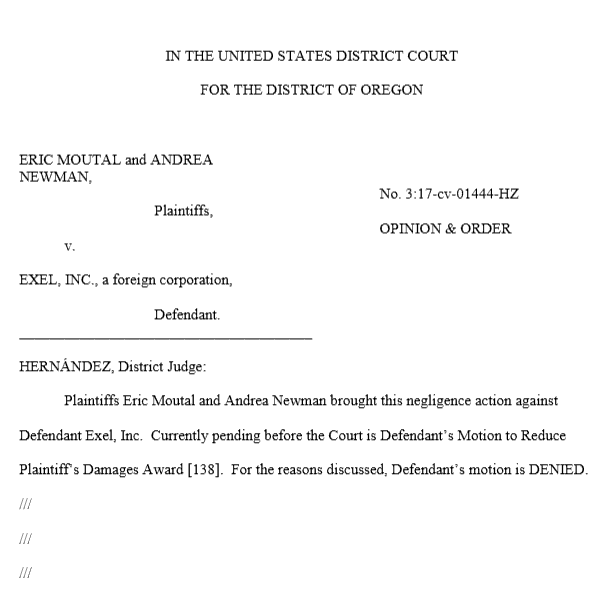
    Consider a truck accident on Interstate 84 near Hood River. In August 2016, two Canadian tourists were riding bicycles legally on the shoulder when a semi-truck driven by an employee of Exel, Inc. struck them from behind. Eric Moutal’s leg was nearly severed.

    The trucking company’s defense came down to one number. The driver was only going four miles per hour over the limit, its lawyers argued, and speeding alone is ordinary negligence under Oregon law.

    Our trial team refused to let the jury judge one fact in isolation. We showed them the whole story. The driver had been drifting onto the shoulder for miles. He had driven past “Bicycles on Roadway” signs more than a thousand times and never noticed them. After the crash, he checked his truck for damage, called his supervisor instead of 911, and then followed witnesses around the scene trying to change their accounts until an Oregon State Trooper told him to stop.

    The federal jury in Portland awarded $4 million in punitive damages: a million dollars for every mile per hour over the limit. The Ninth Circuit court upheld the verdict. (Moutal v. Exel, Inc., No. 3:17-cv-01444-HZ (D. Or. Mar. 29, 2021).) Read more about this verdict here.
    Cases That Changed Oregon Law

    Some cases do more than compensate one family; they can also change the rules for everyone who comes after. Barton Trial Attorneys has spent decades on cases involving powerful institutions that assumed no one would hold them accountable.

    • The first Boy Scouts case to go to trial in the United States. In Wilson v. Tobiassen, Bill Barton represented a Benton County boy abused by his Scoutmaster. It was the first lawsuit against the Boy Scouts of America to reach a jury verdict rather than settle.
    • A rule now written into Oregon’s jury instructions. In Doe v. Oregon Conference of Seventh-Day Adventists (2005), a Marion County jury held a church responsible because its officials knew of the danger and did nothing. The case is cited in Oregon’s Uniform Civil Jury Instructions on constructive knowledge. Bill calls the defense it defeated “ostrich management.”
    • The first lawsuit against the Vatican over clergy abuse. In Doe v. Holy See, a federal judge in Oregon ruled the case could proceed against the Vatican under the Foreign Sovereign Immunities Act, a ruling the Ninth Circuit affirmed in part before the U.S. Supreme Court declined further review.
    • Oregon’s “as is” rule. In a case against a Eugene-area day care, Barton applied the principle that a wrongdoer takes a vulnerable victim as they find them: a defendant can’t escape responsibility because the person it hurt was already fragile.

    These are Oregon cases with local plaintiffs: people who could be your neighbors, friends and community members. Standing up for Oregonians is what matters most to us.

    Speak to an Oregon Personal Injury Attorney

    Working With Barton Trial Attorneys

    Years of experience matter less than what those years were spent doing. Here’s what ours look like.

    Bill Barton earned his law degree from Willamette University College of Law in 1972 and has spent more than five decades as an Oregon trial lawyer. He has been certified by the Oregon Supreme Court as a judge pro tempore, served as president of the Oregon Trial Lawyers Association and the Oregon chapter of the American Board of Trial Advocates, and was inducted into the Trial Lawyer Hall of Fame in 2024. He has been named to Oregon Super Lawyers for more than fifteen years running.

    Brent Barton earned his juris doctorate from Harvard Law School after graduate degrees from Stanford and Cambridge. He served in the Oregon House of Representatives, where he helped write the laws Oregon courts now apply. He has been named to Oregon Super Lawyers and Best Lawyers in America for plaintiffs’ medical malpractice and personal injury litigation.

    Together, the firm brings more than seven decades of combined experience in Oregon courtrooms. We are a boutique personal injury law firm. We take a select few cases at a time and give each one two trial attorneys and a full staff. We are not mass-media advertisers, and we don’t run a volume practice.

    Talk to an Oregon Trial Lawyer About Your Case

    If you were hurt in Oregon, your case will be decided by Oregon law and, if it comes to it, an Oregon jury. You deserve trial lawyers who know both.

    Barton Trial Attorneys handles serious personal injury claims across the state, including car accidents, truck accidents, medical malpractice, birth injuries, and wrongful death. See our results, meet our team, or contact us.

    Call (541) 265-5377 for a free consultation. We take no fee unless we win.

  • Case Results: Inside the Rajneeshpuram Litigation

    In the early 1980s, a religious movement took over a small town in Oregon’s high desert. Its leader, the Bhagwan Shree Rajneesh, was best known as the guru with a fleet of Rolls-Royces. His right hand was his personal secretary, Ma Anand Sheela.

    Most people know the story now from documentaries. I knew it from the inside. For a time, I was one of the lawyers standing between the people of Antelope and the Rajneeshees. This is the story of how I got there, what it was like to face them, and the verdict that came out of it.

    The Rajneeshpuram Litigation: A Timeline

    1981: The Rajneeshees bought the Big Muddy Ranch, a 64,000-acre property near Antelope, Oregon, for $5.75 million. Antelope had about 40 residents. The newcomers began building a city on the ranch. Within months, Antelope’s residents, sensing what was coming, tried to disincorporate their town so it couldn’t be taken over. Rajneeshees registered to vote in Antelope and defeated the measure. 

    May 1982: Residents of the ranch voted to incorporate their own city: Rajneeshpuram. After local elections and resignations, the Rajneeshees held a majority on the Antelope City Council. The Rajneeshee-controlled council eventually renamed Antelope “Rajneesh.” 

    September 1984: Rajneesh personal secretary, Ma Anand Sheela, contaminated salad bars at restaurants in The Dalles with salmonella with the help of her associates. The goal was to make enough voters sick to swing the November Wasco County elections. According to the CDC’s investigation, 751 people became ill in the largest bioterrorism attack in U.S. history. (It also backfired; Residents turned out in force and voted the Rajneeshees down.)

    1985–1986. Sheela fled the country in 1985, and the Bhagwan was arrested and left the United States under a plea agreement. In November 1985, Antelope’s remaining residents voted unanimously, 34 to 0, to take back their town’s name. Sheela was later extradited and, in 1986, pleaded guilty to charges that included attempted murder, assault, and wiretapping. She served 29 months for these crimes.

    How I Became Involved

    Before Antelope, I had done work for John Jaqua, a Eugene lawyer and past Oregon State Bar president. Jaqua helped Phil Knight and Bill Bowerman launch Blue Ribbon Sports, the company that later became Nike, and sat on Nike’s board for decades. 

    Bowerman was the legendary University of Oregon track coach and head coach of the 1972 U.S. Olympic track and field team. His brother lived in Antelope, and openly despised what the Rajneeshees were doing to his town. He called Bill, and Bill called his friend John Jaqua. And that was when John called me.

    How the Rajneeshees Tried To Intimidate Me

    This case was unlike any situation I’d ever encountered, before or since. The Rajneeshees were organized, well-funded, and relentless. They had their own lawyers, their own government, and their own police force.

    Everywhere I went, Sheela seemed to be there. She was striking, sharp, and impossible to ignore. I was reminded of how General Motors once had Ralph Nader followed by private investigators after he exposed the Corvair: a campaign GM’s own president later apologized for before the U.S. Senate. Pressure like that is meant to rattle you—and, honestly, it did for a time—but I redoubled my focus and concentrated on the job at hand.

    Then they came to my home to intimidate me. The Rajneeshees parked a car with two of their members in front of my house in Newport, around the clock, every day. It was meant to intimidate my family and me. I installed a state-of-the-art alarm system, and alerted the Newport police; they parked a marked patrol car, with a city officer, directly behind the Rajneeshees’ car, also around the clock. 

    After three days, the Rajneeshees went home.

    The Defamation Case against Ma Anand Sheela

    During the course of her involvement with the Antelope, OR community, Rajneesh’s personal secretary, Ma Anand Sheela, installed herself as chair of the local school board. When a mother stood up and raised concerns about the curriculum at an open school board meeting, Sheela told the woman that if she had stayed home more, maybe she wouldn’t be a widow. (The woman’s husband, an Oregon State Police officer, had recently died in an accidental shooting.)

    That senseless and cruel comment was meant to humiliate a grieving mother in front of her community. It was the Rajneeshee strategy in miniature: if you couldn’t be outvoted, you could be shamed into silence.

    In 1985, I filed a defamation case on the woman’s behalf against Sheela.

    Sheela’s lawyer was Swami Prem Niren, also known as Philip Toelkes: the Bhagwan’s personal attorney and, by then, the elected mayor of Rajneeshpuram. Niren was one of the most skilled trial lawyers I have ever faced. He was smart, prepared, and persuasive.

    Nevertheless, the jury returned a verdict of $625,000 for my client. You can see this verdict, along with others, on our Results page.

    40 Years Later: Why The Rajneeshpuram Litigation Still Matters

    Our successful defamation verdict did not bring back our client’s husband. It didn’t end the Rajneeshee era on its own, or stop the tsunami of outside money that essentially bought a town. What it did was tell one woman, in front of her whole community, that what Ma Anand Sheela said to her was wrong—and that the Rajneeshees, regardless of their influence, had to follow the law like everyone else.

    That is what juries are for, and why my legal career has centered around the power of ordinary people. When power is concentrated in the hands of people who think the rules don’t apply to them, a jury of ordinary citizens is one of the few places where everyone stands on equal ground.

    I’ve carried that lesson through my career. I took this mission into the first lawsuit against the Boy Scouts of America to go to trial, the first lawsuit against the Vatican over clergy abuse, and the institutional abuse cases our firm still takes today. Our opponents will change, but our work—our values—never will. 

    You find the person who was hurt, you tell their story truthfully, and you don’t back down, even when the other side plays dirty.


    Barton Trial Attorneys: Standing Up to Powerful Opponents for More than 40 Years

    When people come to us, they almost always say they don’t want what happened to them to happen to anyone else. That is why we do this work: to level the playing field between ordinary people and entities that are bigger, richer, and better organized than the people they hurt. ‘

    As a boutique trial firm accepting only a handful of cases at a time, we’ve successfully taken on religious movements, national institutions, hospitals, and corporations. Learn more about our firm, our core values, and our team — or call for a free consultation:

    Barton Trial Attorneys. You’re not a file. You’re family.

  • The Judge’s Lawyer: Representing Edward Leavy at the U.S. Supreme Court

    Judges watch lawyers for a living. They see who comes to court prepared and who doesn’t. They see who tells the truth when it hurts their case, and who stretches it; they see who the jury believes. 

    Few people in American history watched as many trial lawyers as Judge Edward Leavy.

    Ed Leavy: One of Oregon’s Most Honored Trial Judges

    Ed Leavy (1929–2023) was born on his family’s hop farm near Butteville, Oregon, the youngest of ten children of an Irish immigrant. He graduated from the University of Portland and Notre Dame Law School, then went to work as a deputy district attorney in Eugene. In 1957, he became a judge, and served in seven courts over the next six decades. 

    Leavy was a Lane County district judge and circuit judge. He sat as a justice pro tem on the Oregon Supreme Court. He served as a U.S. magistrate judge and then a U.S. district judge in Portland, where he oversaw plea negotiations with the Bhagwan Shree Rajneesh and his followers. As a mediator he settled complex cases, including precedent-setting disputes involving the Warm Springs, Umatilla, and Yakama tribes and the federal government.

    President Reagan appointed him to the Ninth Circuit Court of Appeals in 1987, and Chief Justice Rehnquist later named him to the Foreign Intelligence Surveillance Court of Review, where he served as presiding judge.

    Ed Leavy Wins The Nobel Prize of the Federal Judiciary

    In 2015, Judge Leavy received the Edward J. Devitt Distinguished Service to Justice Award, often called the Nobel Prize of the federal judiciary. A panel of federal judges, chaired that year by Justice Clarence Thomas, selects one federal judge for distinguished service to justice.

    The award was presented on November 13, 2015, at the United States Supreme Court in Washington, D.C. Chief Justice John Roberts and Justices Anthony Kennedy, Sonia Sotomayor, and Clarence Thomas were there. Justice Kennedy even serenaded Judge Leavy’s wife, Eileen, whose birthday fell on the same day.

    Above all, he was humble. Judge Diarmuid O’Scannlain, his longtime neighbor in Portland’s Pioneer Courthouse, put it simply: “Judge Leavy is the genuine article.”

    Speaking for Judge Leavy Before the Supreme Court: The Honor of a Lifetime

    The honoree was allowed one lawyer to speak on his behalf. After nearly sixty years of watching thousands of lawyers—prosecutors and defense attorneys, Plaintiffs’ lawyers and corporate counsel—Judge Ed Leavy chose me as his personal representative.

    I was honored beyond words. In my address, I channeled Justice Oliver Wendell Holmes Jr., one of the great figures in American law and a personal idol of my own. Both Justices understand not just what the judicial bench represents, but what trial lawyers like myself are capable of.

    An attorney’s trust is earned one case at a time, over years. We must show up for every client, every day: prepared, forthright, and respectful of every person in the courtroom. Judge Leavy spent his life showing what a fair, humble, decent judge looks like. I’ve tried to spend mine being the kind of lawyer he would trust. 

    This remains the standard we hold ourselves to at Barton Trial Attorneys, for every client and in every case.

    Ed Leavy died on March 12, 2023, at the age of 93. The Ninth Circuit’s chief judge called him “a legend in Oregon and on this court,” and indeed he was. I am grateful to have practiced in his courtroom, and to have had the privilege of honoring him before the Supreme Court.


    If you or someone you love has been seriously hurt, Barton Trial Attorneys is here for you. We take only a handful of cases at a time, and every client receives the attention of two trial attorneys and a full administrative staff. Learn more about our firm and our team, or contact us to learn more.

    Call (541) 265-5377 for a free consultation.

  • Hit by a Semi or Commercial Truck? What to Do Next

    Semi truck accidents are not simply bigger versions of a car accident. A loaded tractor trailer can weigh more than 80,000 pounds; the injuries are worse, the regulatory rules are different, and multiple parties are often involved. If you or someone you love was just hit by a semi or other commercial truck, here is what to do next.

    Hit By a Commercial Truck in Oregon? Call Barton Trial Attorneys: (541) 265-5377

    What to Do After Being Hit by a Commercial Truck

    1. Get medical care right as soon as possible.

    Call 911, accept medical  transport if it is offered, and see a doctor even if you feel fine. Adrenaline masks pain. Brain injuries and spinal injuries often show symptoms hours or days later, and many injuries are never reported at the scene. A prompt medical record also connects your injuries to the crash. This is the single best way to preserve the integrity of your insurance claim.

    2. Call the police at the scene and file a report.

    In Oregon, drivers involved in a crash causing injury must stop, help the injured, and exchange information. Ask for the responding officer’s name and agency and the report number. If you are able, tell the officer plainly what happened. Do not guess, and do not apologize; an apology at the scene can later be framed as an admission.

    3. Document the scene.

    Documenting the scene is one of the most valuable things you can do, but only if you are physically able. If you can’t, ask another person on the scene for assistance. Capture:

    • The truck’s DOT number, trailer number, and company name on the door
    • Both vehicles’ positions and damage
    • Skid marks, debris, road conditions, signage, and weather
    • Hazmat placards or cargo spills
    • Your visible injuries
    • Names and phone numbers of witnesses, including drivers who stopped

    4. Preserve your vehicle and your medical records

    Treat both as evidence in an ongoing legal case; do not let your car be repaired, sold, or scrapped. Keep every medical bill, prescription receipt, and pay stub. We also recommend that you keep a short daily journal of your pain, your limitations, and what you can no longer do; this can be compelling evidence of your pain and suffering, particularly if it is corroborated with other evidence.

    5. Speak with a truck accident attorney to discuss your options.

    The most important evidence in a trucking case belongs to the trucking company. A preservation letter sent in the first week can protect black box data, logbooks, and camera footage. A letter sent in month six may arrive after it is gone. An experienced truck accident attorney knows what to demand, from whom, and how fast. Call Baron Trial Attorneys at (541) 265-5377 for a free consultation.

    Do not talk to the trucking company’s insurance company.

    You may get a call within days, sometimes within hours. The adjuster may sound helpful. Their job is to close the insurance claim for as little as possible. Do not give a recorded statement, do not sign a medical authorization, and do not accept a settlement before a lawyer has reviewed it. Once you sign a release, the claim is over, even if you need another surgery next year.

    Why Commercial Truck Accidents Are Special

    Commercial truck accidents differ from ordinary collisions in the following ways:

    The injuries are often catastrophic.

    Large trucks cause traumatic brain injuries, spinal cord injuries, amputations, crush injuries, and burns. In accidents involving large trucks, the people killed are overwhelmingly the occupants of passenger vehicles.

    The industry is federally regulated.

    Commercial drivers and the companies that employ them must follow the Federal Motor Carrier Safety Regulations: rules on driving hours, driver qualification, drug and alcohol testing, inspections, maintenance, and cargo securement. Every one of those rules is a measure of what safe conduct looks like, and every violation is potential evidence.

    Much of the evidence is electronic, and it disappears.

    As we have written, Engine control module data, electronic logging device records, dash camera footage, telematics, and dispatch messages can all show exactly what happened. Much of it is overwritten or purged on routine schedules.

    There are often multiple parties.

    A single commercial vehicle accident can involve the truck driver, the motor carrier, a freight broker, the shipper, the company that loaded the cargo, a maintenance contractor, and a parts manufacturer, each with its own insurance company and its own lawyers. When multiple commercial parties share responsibility, each one has a reason to blame the others—and all of them have a reason to blame you.

    Work with an Oregon Truck Accident Attorney

    Oregon Statutes That May Affect Your Truck Accident Case

    Statute of limitations

    Most personal injury claims in Oregon must be filed within two (2) years of the injury. Miss the deadline and the case is gone, no matter how strong it is.

    Wrongful death

    When a truck crash takes a life, the personal representative of the estate may bring a wrongful death claim. It generally must be filed within three (3) years after the injury causing the death is discovered or reasonably should have been discovered, and no later than three years after the death. Oregon’s damages rules for wrongful death are different from those for injury claims (Learn more on our wrongful death attorney page.)

    Claims against a public body

    If the truck belonged to a city, county, transit agency, or the state, the Oregon Tort Claims Act applies. Written notice is generally required within 180 days of the injury (or one year for wrongful death). The lawsuit itself must usually be filed within two years. 

    Comparative fault

    Oregon employs modified comparative fault which means that you can recover damages as long as your fault was not greater than half. Your recovery is reduced by your percentage of fault; at 51 percent, you recover nothing. The defense will try to cross this threshold by claiming you were in a blind spot, braked suddenly, or changed lanes carelessly. If they successfully do so, they pay nothing, even if their driver was partially responsible.

    Noneconomic damages

    Oregon sets a $500,000 cap on noneconomic damages such as pain and suffering. But in Busch v. McInnis Waste Systems, Inc., 366 Or 628 (2020), the Oregon Supreme Court held that the cap violates the Oregon Constitution’s remedy clause when applied to an injured person’s own claim. For survivors of a truck crash, a jury’s full award for pain and suffering stands.

    Punitive damages

    Oregon allows punitive damages when there is clear and convincing evidence that a defendant acted with malice or showed a reckless and outrageous indifference to a highly unreasonable risk of harm. Under ORS 31.735, most of a punitive award goes to the state (60 percent to the Criminal Injuries Compensation Account and 10 percent to court facilities) with 30 percent to the injured person.

    Commercial motor carrier rules

    Oregon adopts the core Federal Motor Carrier Safety Regulations, covering such things as hours of service, driver qualification, drug and alcohol testing, and vehicle inspection and maintenance. It applies them to both interstate carriers and, with certain exceptions, carriers operating only within Oregon. 

    Distracted driving

    Oregon prohibits driving while holding or using a mobile electronic device. Commercial drivers are subject to narrow exceptions only where federal regulations permit device use within the scope of their job. The federal rules themselves bar commercial drivers from texting or using a hand-held phone while driving.

    Duties after a crash and DMV reporting

    Drivers involved in a crash that injures someone must stop, give their information, and render reasonable aid. Oregon DMV also requires a driver to file a Traffic Collision and Insurance Report within 72 hours if anyone was injured or killed, or if property damage exceeds $2,500. A police report does not replace your DMV report.

    Read More from Barton Trial Attorneys: How Federal Trucking Rules Prove Fault

    What You Can Recover

    A truck case valued from the medical bills alone is undervalued from the start. A properly built claim accounts for:

    • Past and future medical care, rehabilitation, and attendant care
    • Lost wages and lost earning capacity
    • Pain and suffering, disfigurement, and loss of enjoyment of life
    • Home and vehicle modifications and medical equipment
    • Property damage
    • Loss of consortium for a spouse
    • In a fatal crash, the losses Oregon’s wrongful death statute recognizes for the family
    • Punitive damages, where the conduct was reckless or outrageous

    Federal law requires most interstate carriers hauling general freight to carry at least $750,000 in liability coverage, and many carry far more through layered excess policies. Those policies often surface only when a case is prepared seriously.

    Frequently Asked Questions about Oregon Truck Accidents

    How long do I have to file a truck accident claim in Oregon?

    Generally, two (2) years from the date of the crash, and three (3) years if the accident resulted in a wrongful death. If a government vehicle was involved, written notice is usually required within 180 days. We strongly recommend contacting an Oregon truck accident attorney as soon as possible to discuss your options.

    Who can be held responsible besides the truck driver?

    Often, several parties. The trucking company, the trailer owner, the freight broker, the shipper, the loader, a maintenance contractor, and a parts manufacturer may all share responsibility. Identifying every one of them early is how a case reaches the insurance coverage it needs.

    Should I talk to the trucking company’s insurance adjuster?

    Not before you talk to a lawyer. Recorded statements are used to lock in words that can be turned against you. Early offers arrive before anyone knows the full cost of your care.

    What if I was partly at fault?

    You can still recover compensation, as long as you were not more at fault than the defendants combined. Your award is reduced by your share of fault. Being blamed by the truck driver at the scene doesn’t decide anything.

    Is a truck accident case different from a car accident case?

    Yes, in almost every way. Truck cases involve federal regulations, corporate defendants, electronic evidence, and much larger insurance policies. If your crash involved only passenger vehicles, see our car accident page.

    My loved one suffered a brain injury in the crash. What should we know?

    Brain injuries are frequently missed during early medical exams, but can change a family’s life permanently. Get a full neurological evaluation and keep records of every change in memory, mood, and behavior. Learn more on our traumatic brain injury page.

    How much does it cost to hire an Oregon truck accident attorney?

    Nothing upfront at Barton Trial Attorneys. We work on contingency, which means we recover no legal fee unless we recover for you. Our consultation is free. See our Client FAQ for more.

    A Truck Accident Law Firm That Treats You Like Family

    Accident victims of semi truck crashes face a team of investigators, adjusters, and defense lawyers that went to work within hours. We believe victims of serious truck accidents deserve a legal team that works just as hard for them. As a boutique Oregon law firm, we accept only a handful of cases at a time, and devote two trial attorneys and a full staff to each one.