
Why National Firms Bring Cases to Oregon Local Counsel
Some of the biggest personal injury firms in the country advertise in every state. You’ve probably seen their billboards on I-5; their commercials run during the evening news from Portland to Medford. Here’s something those late-night commercials will never tell you: when one of those massive firms signs a serious case that will be decided in Oregon, it usually calls a local attorney to steward the process.
A national personal injury firm can bring money, staff, and experience with a particular kind of case; a local firm brings a working knowledge of Oregon law, and years of standing in front of Oregon juries. This blog explains why the partnership exists, what each side brings, and what it means for the injured person at the center of the case.
If you are working with an out-of-state attorney, Oregon trial lawyers Bill and Brent Barton may still be of help in your case. Call (541) 265-5377 to learn more about how we can help. Our practice includes truck accidents, medical malpractice, birth injuries, and wrongful death.
State Law Requires Oregon Law Firms’ Involvement
A lawyer licensed in another state cannot simply file a lawsuit in Oregon and try it. By Oregon law, an out-of-state attorney may appear in an Oregon case only if the attorney is “associated with an active member of the Oregon State Bar.” The court rules go further; the Oregon lawyer must sign the request for permission to appear and “must participate meaningfully in the matter.”
The federal court in Oregon has its own rules for lawyers from other states, and they also require ties to local counsel. The Oregon lawyer is not just a name on a letterhead; by law, they are expected to be actively involved in the case throughout the process.
Oregon Laws That Can Affect Your Case
Even setting the licensing rules aside, a case decided under Oregon law needs someone who knows Oregon law inside and out. Here are just few examples of Oregon laws that distinguish us from other states:
- No cap on noneconomic damages in personal injury cases. In Busch v. McInnis Waste Systems (2020), the Oregon Supreme Court held that the state’s $500,000 cap could not be applied to an injured person’s claim. A firm used to working under caps in other states may value an Oregon case too low.
- Modified comparative fault. Under ORS 31.600, an injured person can recover as long as they were not more at fault than the defendants. Neighboring states use different rules; a pro hac vice Oregon lawyer will be able to anticipate this legal challenge.
- Non-unanimous civil juries. In Oregon civil cases, three-fourths of the jury can return a verdict. That changes how a trial lawyer both picks a jury and builds a case.
- Strict deadlines. Most Oregon injury claims must be filed within two (2) years under ORS 12.110. Claims against public bodies can require written notice in as little as 180 days. Oregon-based personal injury attorneys are prepared to meet these deadlines.
- Oregon’s own jury instructions. Oregon judges instruct juries using the Uniform Civil Jury Instructions. Our firm’s case, Doe v. Oregon Conference of Seventh-Day Adventists (2005), is cited in those instructions on constructive knowledge. When the instructions themselves cite your local counsel’s cases, having them by your side can only benefit your case.
- Oregon state courts have very limited pre-trial discovery, i.e., no depositions of experts, no interrogatories, and no remittitur — this means you have to be prepared and good on your feet.
Work with Barton Trial Attorneys: Oregon Lawyers for Oregon Cases
Oregon Juries Will Vary by County
Anyone from Oregon knows how diverse our social and political landscape can be. A jury in Portland is not a jury in Roseburg; a jury in Salem is not a jury in Bend. For some cases, the venue matters almost as much as the fact of the case. So does knowing how a particular community thinks about responsibility, money, and fairness. Out-of-state law firms will not recognize these differences, but local law firms will.
Bill Barton has spent more than five decades trying cases in Oregon courtrooms, from a defamation trial against the Rajneeshees in the 1980s to an obstetrical malpractice trial in Roseburg where we covered the courtroom in enlarged fetal monitor strips so jurors could watch a baby’s decline hour by hour. That kind of experience is built one Oregon jury at a time.
Local Trial Lawyers Get Better Results
Insurance companies and defense firms keep track of which plaintiffs’ lawyers will actually go to trial. They set reserves and make offers with that in mind. When a national firm partners with Oregon trial counsel that has a record of verdicts in the state, the defense generally takes the case more seriously.
As trial lawyers, our reputation often precedes us in Oregon courtrooms. As one example: in Goddard v. Farmers, Barton Trial Attorneys fought an insurer that refused to pay a judgment against its drunk-driving policyholder. The fight lasted 21 years, and went through seven appeals before an Oregon jury returned a punitive damages verdict against Farmers. Defense lawyers in this state remember cases like that—and national firms will use our reputation to their advantage as we co-counsel on out-of-state cases.
I hired a national firm but my case is in Oregon. Can I still use local counsel?
If you hired a national firm and your case is in Oregon, you may be able to request local counsel to improve the outcome of your case. This allows you to use the national firm’s resources and specialized experience, along with an Oregon trial lawyer’s knowledge of the law, the courts, the judges, and the juries.
Here are a few questions worth asking any out-of-state firm handling your Oregon case:
- What Oregon counsel are you using? Ask for a name of the firm, and do your due diligence. Not all local firms will have the experience you need, especially if your case involves a commercial defendant, contested liability, multiple defendant parties and so on.
- Has the local lawyer tried cases to verdict in Oregon? It is important that your local attorney has not merely settled cases in Oregon, but tried cases, to verdict, in Oregon courts.
- What will our Oregon counsel actually do on the case? Will they take depositions, argue motions, pick the jury? Local firms may know the political terrain better than an out-of-state entity. Having their guidance in the courtroom can be crucial to your case.
- Who will stand up in court if the case goes to trial? Not all trial lawyers are created equal. An experienced Oregon personal injury attorney—one who goes to court as part of their job—will likely have a better outcome than an out-of-state attorney who is new to standing before a jury.
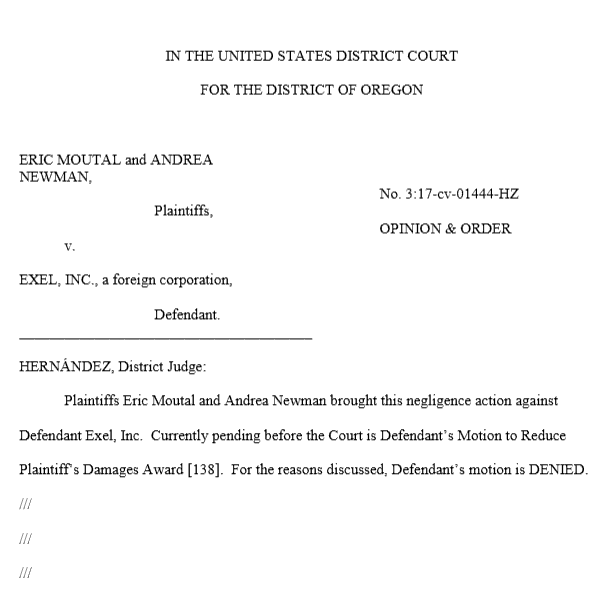
It also works the other way; people who live far away are often hurt here. For example: in Moutal v. Exel, Inc., our clients were Canadian tourists struck by a semi-truck while bicycling on the shoulder of Interstate 84 near Hood River. They went home to Canada, but their case stayed in Oregon. We tried it in a federal court in Portland, and an Oregon jury heard it. The federal court upheld a $4 million punitive damages award.
Read More about Moutal v. Exel, Inc.
Barton Trial Attorneys Outside Oregon: Trying a Case in Hawaii
The team at Barton Trial Attorneys knows the local-counsel relationship from both sides; we serve as Oregon counsel for lawyers from other states. As one example: Bill Barton tried a case in federal court in Honolulu, before U.S. District Judge Samuel P. King.
Judge King was a fixture of the Hawaii federal bench for nearly four decades and had a reputation as one of the toughest judges a trial lawyer could draw. He ran his courtroom on his own schedule. Bill had prepared a five-day trial; Judge King gave him just two days.
There was no time to try the case the way it had been planned. So Bill tried it the way he now teaches young lawyers to try every case: ABC (Accurate, Brief, and Clear). He cut every witness who wasn’t essential; he streamlined every exhibit that didn’t move the story forward. He told the true story of what happened to his client in plain English and trusted them with it.
The court returned a significant verdict for his client.
The lesson for any firm working outside its home state is the one Bill learned in Honolulu: we don’t get to bring our home courtrooms with us; you must adapt to the judge, the rules, and the jury in front of you, or you lose. We bring this lesson to every out-of-state client we take.
Work with an Oregon Trial Lawyer
Working with a National Law Firm? Talk to Oregon Trial Counsel
Whether you are an injured person whose case belongs in Oregon or a lawyer from another state with a serious case here, we’d be glad to talk. Barton Trial Attorneys takes just a handful of fewer cases at a time, and devotes two trial attorneys and a full staff to each one. We advance case costs, and we work alongside referring and co-counsel attorneys as closely as they’d like.
Call (541) 265-5377 for a free consultation.
Barton Trial Attorneys. You’re not a file. You’re family.